

Spring Travel Bed Bugs in Porter Ranch, CA | Bugs A to Z
Spring Travel Bed Bugs in Porter Ranch, CA | Bugs A to Z
Spring travel — flights to see family, weekend getaways to Vegas, kids visiting friends in dorms — is exactly when bed bugs find their way into Porter Ranch homes. By the time we get the call, the bugs have usually been hiding behind a headboard or inside a suitcase for weeks. Bed bug control in Porter Ranch, CA is one of the more time-sensitive jobs we run, because every week that passes lets a single fertilized female grow into a cluster of dozens.
At Bugs A to Z, we serve Porter Ranch and the rest of the northwest San Fernando Valley. This guide covers why spring drives the surge, how bed bugs hitchhike home, what to inspect before you unpack, the early signs in your bedroom, why DIY sprays fail, what works in Southern California, and when to call us.
Why Spring and Summer Travel Drives Bed Bugs Into Porter Ranch Homes
Bed bugs do not fly or jump, and they do not wander beyond a few rooms on their own. They spread by riding human luggage, clothing, and shared transport. The CDC and EPA point out that the rise in bed bug cases since the mid-1990s tracks directly with increased travel volume — not with sanitation or housing quality.
Spring break, Easter trips, late-spring weddings, and the start of summer vacation all put Porter Ranch families on planes, trains, ride shares, and into hotel beds at exactly the moment bed bugs are most active in those settings. Hotel turnover is at its peak, housekeeping cycles are compressed, and a single unreported infestation in one guest room can seed dozens of suitcases over a single weekend.
Porter Ranch sits where heavy travel intersects with the kinds of homes bed bugs love — multi-bedroom layouts, plush bedding, and upholstered furniture that gives them dozens of harborage points. Once a few hitchhikers reach a master bedroom, they slip behind the headboard, into the box-spring seam, or under the carpet edge — and the clock starts on a full infestation.
How Bed Bugs Hitchhike on Luggage, Clothes, and Strollers
Picture a bed bug as an apple-seed-sized hitchhiker that always picks the warmest, darkest, most cluttered spot near a sleeping person. That is exactly what suitcases, duffel bags, backpacks, and stroller storage compartments offer.
The most common pickup points we see in Porter Ranch cases:
- Hotel and short-term rental beds — Bed bugs feed at night, then return to harborage within a few feet of the bed. A suitcase placed on the floor next to that bed, or on a luggage rack against the same wall, is well within their normal travel range.
- Soft-sided airline luggage — Fabric seams, zipper folds, and exterior pockets give bed bugs hundreds of crevices to settle into.
- Sleepover backpacks and gym bags — Kids and teens move bags between dorm rooms, friends' houses, and travel destinations without ever inspecting them.
- Strollers and car seats — Strollers parked in hotel rooms regularly carry bed bugs out of the building. Car seats with fabric covers are a particular concern.
- Theater seats and rideshare interiors — Less common, but documented in dense urban travel corridors.
EPA travel guidance warns travelers to keep luggage off the floor and bed, on a luggage rack pulled away from the wall — exactly because bed bugs do not move far on their own.
What to Inspect at the Hotel Before You Unpack
Five minutes of inspection at check-in is the single most effective bed bug prevention step a Porter Ranch family can take all year. We walk every client through the same routine.
Step 1 — Park your suitcase in the bathroom
Bed bugs almost never harbor in tile bathrooms; the floor and tub are inhospitable. Keep luggage on the bathroom floor or inside the empty tub while you inspect the rest of the room.
Step 2 — Inspect the bed
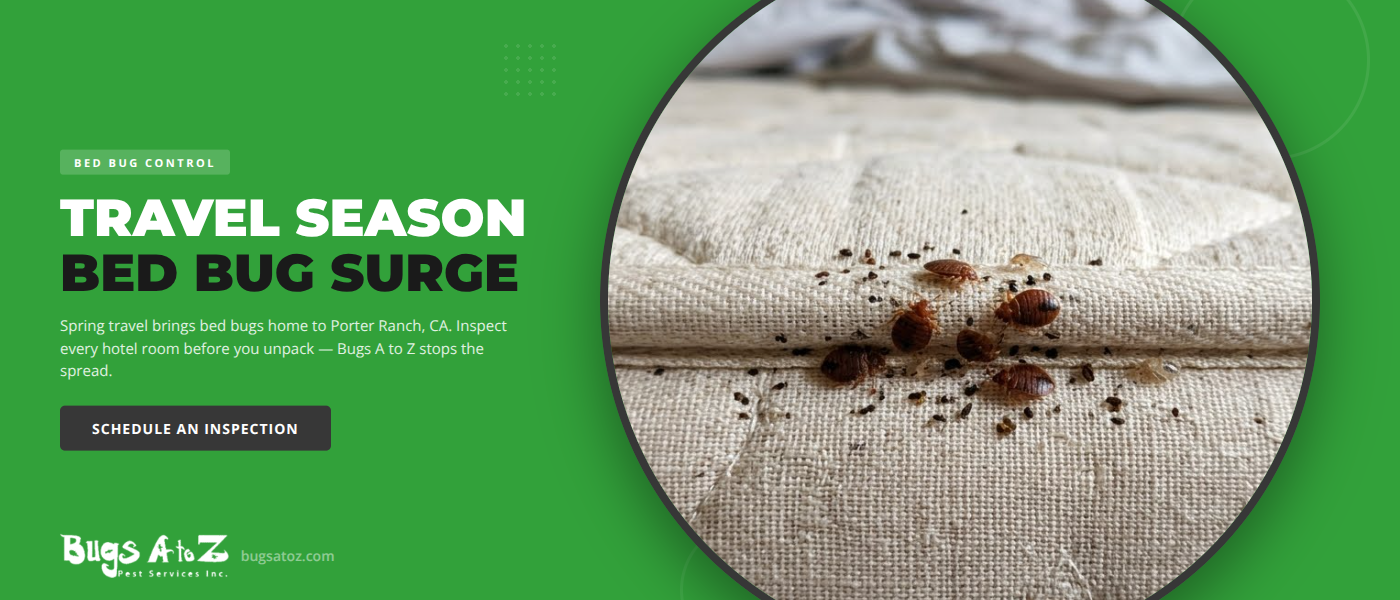
Pull the sheets back at the head of the mattress and look at the seam, the piping, and the corners of the box spring. Live bed bugs are reddish-brown and roughly the size of an apple seed. The bigger giveaway is what they leave behind: dark pinpoint stains that look like felt-tip marker dots, shed skins, and rust-colored smears along the seams.
Step 3 — Check the headboard and surrounding furniture
Headboards bolted to the wall are a favorite harborage. Use a flashlight to scan along the top edge, the back, and any cracks where the headboard meets the wall. Then check nightstands, drawer joints, and the edges of upholstered chairs.
Step 4 — Scan the wall edges
Look at the carpet edge along the wall closest to the bed, and at any peeling wallpaper or loose moulding. Bed bugs migrate to those edges as populations grow.
If anything looks suspicious — even one stain or shed skin — request a different room on a different floor, not next door. Bed bugs migrate horizontally through baseboard and conduit, so the room next to a known infestation is the worst possible reassignment.
Early Signs of Bed Bugs in Your Porter Ranch Bedroom
The hardest part of detecting bed bugs at home is that the early signs are easy to dismiss. The first week after a trip, almost no one is looking. By the time bites or visible bugs make it impossible to ignore, the infestation has usually been growing for a month or more.
The early signs we coach Porter Ranch homeowners to watch for:
- Small, itchy bites in lines or clusters — Bed bug bites often appear in groups of three or in a rough line, on areas exposed during sleep (arms, neck, ankles, back). Some people do not react at all, which makes bites unreliable as a sole indicator.
- Pinpoint dark dots on sheets or the mattress seam — Digested blood spotting along seams is one of the most reliable visual cues.
- Rust-colored smears on pillowcases — These are crushed bugs, often after a sleeper rolls onto one in the night.
- A faint sweet, musty odor — Heavy infestations have a distinctive odor; light ones generally do not.
- Tiny shed skins along the box spring or behind the headboard — Bed bugs molt five times before reaching adulthood, so castings accumulate quickly in hidden corners.
The University of California Statewide IPM Program notes that bed bugs have never been shown to transmit human disease, but the combination of bites, anxiety, and disrupted sleep makes them one of the most stressful pests we treat in Porter Ranch.
Why DIY Bed Bug Sprays Fail to Stop an Infestation
The shelf at any Porter Ranch hardware store has a half-dozen "kills bed bugs" aerosols. They almost never solve the problem.
Three reasons, in order of how often we see them:
- Resistance — Decades of over-the-counter pyrethroid spray have produced widespread bed bug populations that simply do not die from a household aerosol. The joint CDC and EPA statement on bed bug control cites pesticide resistance as a major driver of the resurgence.
- Hidden harborage — Sprays only work on surfaces they actually touch. Bed bugs spend roughly ninety percent of their lives in cracks, seams, and voids — inside box-spring fabric, behind baseboard, under carpet edge tack strip, inside electrical outlets. A mattress spray kills the few visible bugs and leaves the gravid females and eggs untouched.
- Eggs — Bed bug eggs are protected by a glue-like coating that most contact insecticides do not penetrate. Even when the active ingredient kills adults, eggs hatch a week or two later and the cycle restarts.
The end result of an aggressive DIY spray campaign is usually the same: bed bugs scatter, harborage gets harder to find, and the cost of professional treatment goes up.
Heat Treatment vs. Chemical Treatment: What Works in Southern California
For confirmed bed bug infestations in Porter Ranch, two professional options dominate.
Heat treatment raises the entire treatment area to roughly 120–135°F and holds it there for several hours. At those temperatures, every life stage — adults, nymphs, and eggs — dies. Bed bugs cannot develop resistance to heat the way they can to chemistry, which is the strongest argument in heat's favor. Heat penetrates seams, cracks, and concealed harborage that surface sprays cannot reach. The trade-off is that heat is a single-event treatment with no residual; if a few bugs survive a cold pocket of the room or get reintroduced afterward, the population can rebuild.
Chemical treatment uses targeted residuals — typically non-repellent products applied to specific harborage points along baseboards, behind outlet plates, and into the box-spring frame. Chemical treatments take multiple visits and demand strict prep on the homeowner side, but the residual continues working for weeks, which catches late-hatching eggs and any bug that wanders into a treated zone.
Many Porter Ranch jobs we run are hybrids — a single heat session followed by a residual perimeter and a follow-up two to three weeks later. The exact mix depends on the room layout, infestation size, and household details such as electronics and pets.
How Bugs A to Z Stops Bed Bugs in Porter Ranch Homes
Our process for bed bug control in Porter Ranch, CA starts with a property inspection — typically the bedrooms first, then the rest of the home. We confirm the species, map active harborage, and identify the introduction path so we can advise on what to do with luggage, clothing, and any items that traveled with the family.
From there, we build the treatment plan around the infestation rather than around a one-size product line:
- Light, recently introduced infestations often respond to targeted residual treatment plus a controlled heat session over the bed.
- Larger or whole-room infestations move to full-room heat with a residual perimeter and follow-up inspection.
- Multi-room or multi-bed cases get a phased plan with prep coaching, two scheduled visits, and a confirmation walkthrough.
We coordinate with families to handle pets, fish tanks, and heat-sensitive electronics ahead of any heat work. Many Porter Ranch customers fold bed bug coverage into our broader residential pest control program once the immediate problem is resolved, which gives us a baseline to catch any reintroduction quickly.
We serve Porter Ranch along with Granada Hills, Northridge, Chatsworth, Woodland Hills, and the rest of the Valley. To schedule an inspection, reach us through our contact page.
Frequently Asked Questions About Spring Travel Bed Bugs in Porter Ranch
How quickly do bed bugs spread after a trip?
A single fertilized female can lay one to five eggs per day for several months. From a single hitchhiker in a Porter Ranch suitcase, a noticeable infestation typically becomes visible in four to six weeks.
Can bed bugs travel through hotel walls between rooms?
Yes. They migrate along electrical conduit, plumbing chases, and shared baseboard between adjoining rooms. That is why we tell travelers who find bed bugs in a hotel to request a room on a different floor — not the room next door.
Do hotel star ratings predict bed bug risk?
Not really. The CDC and EPA both note that bed bug reports come from hotels at every price point. Inspection at check-in is more reliable than any rating system.
How should I unpack when I get home?
Unpack outside, in a garage, or directly into the laundry room — not in the bedroom. Run all clothing through a hot dryer for at least 30 minutes; heat, not water, kills bed bugs and eggs. Inspect the suitcase, store it away from sleeping areas, and bag anything that cannot be heat-treated.
Are your bed bug treatments designed with families and pets in mind?
Yes. We walk every Porter Ranch household through prep, including pets, electronics, and heat-sensitive items, and we use the lowest-impact effective approach for each room.
How long does professional bed bug treatment take to clear a home?
Most Porter Ranch jobs are clear within two to four weeks from the first visit, with a follow-up inspection around day fourteen to twenty-one to confirm the infestation has collapsed.